If you are planning to renovate your kitchen, add a new room, or fix that leaky roof, a credit union home improvement loan could be the smartest financing decision you make. Credit unions have become a go-to option for homeowners who want better rates, lower fees, and a more personal lending experience. In this comprehensive guide, we cover everything you need to know about getting a credit union home improvement loan — from how it works to how to qualify and apply.

What Is a Credit Union Home Improvement Loan?
A credit union home improvement loan is a type of personal or secured loan offered by a credit union to help homeowners finance renovation, repair, or upgrade projects on their property. Unlike traditional bank loans, these loans come from member-owned financial cooperatives — institutions that are not driven by shareholder profit but by the financial well-being of their members.
Credit unions offer home improvement loans in several forms, including personal (unsecured) loans, home equity loans, and home equity lines of credit (HELOCs). Each type serves a different need, and understanding the difference can help you choose the right one for your project.
Credit Union vs. Bank Home Improvement Loan: What Is the Difference?
Many homeowners are surprised to discover how different the experience is when borrowing from a credit union compared to a bank. Here is a breakdown of the key differences:
- Lower Interest Rates: Because credit unions are non-profit, they typically offer significantly lower interest rates on home improvement loans than banks or online lenders. Even a 1–2% difference in rate can save you thousands of dollars over the life of a loan.
- Fewer Fees: Credit unions tend to charge fewer and lower fees — you may encounter little to no origination fee, no prepayment penalties, and lower processing charges.
- Flexible Qualification Criteria: Credit unions often look at the whole picture of your financial situation rather than relying solely on your credit score. This makes them more accessible for borrowers with less-than-perfect credit.
- Personalized Service: Credit union staff are members of the same community and often take a more hands-on approach to helping you understand your options.
- Member Ownership: You are not just a customer at a credit union — you are a member and part-owner. This means the institution works for your benefit, not for external investors.
Types of Credit Union Home Improvement Loans
Credit unions offer multiple home improvement financing options. Understanding each type helps you choose the best one for your needs and budget.
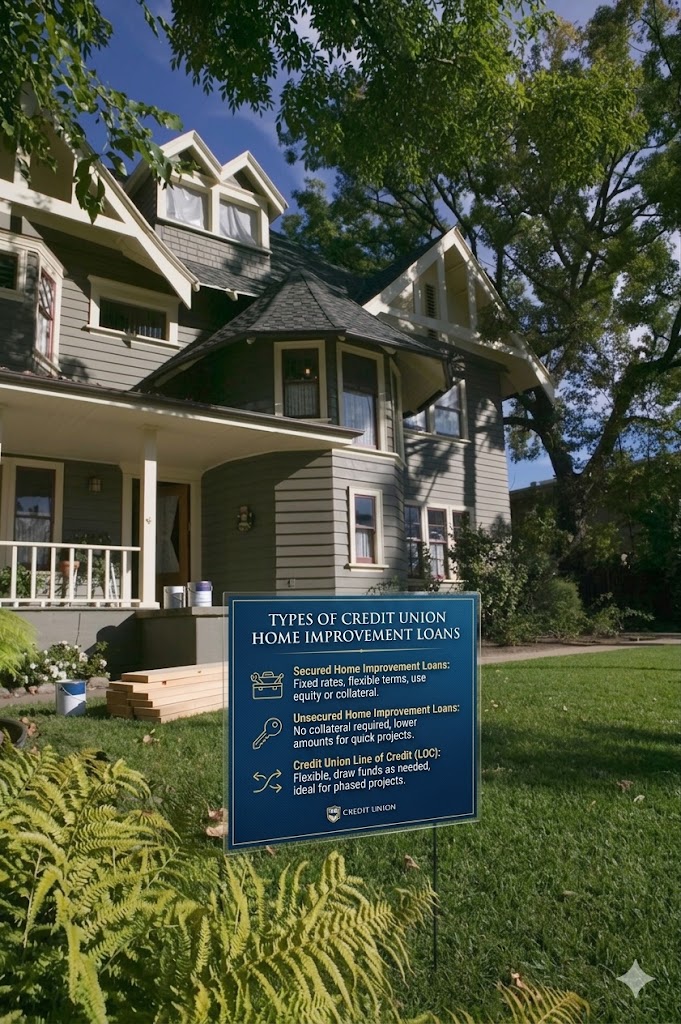
1. Personal (Unsecured) Home Improvement Loan
This is the most straightforward option. A personal loan from a credit union requires no collateral — you borrow a lump sum and repay it in fixed monthly installments over a set term, typically between 12 and 84 months. This is ideal for smaller projects like bathroom remodels, flooring upgrades, or window replacements. Since no collateral is required, the interest rate may be slightly higher than a secured loan, but credit union rates are still competitive.
2. Home Equity Loan
A home equity loan allows you to borrow a lump sum using your home as collateral, based on the equity you have built up in it. Because it is secured, interest rates are lower than unsecured personal loans. The loan is repaid in fixed monthly installments, making it easy to budget. This type is best for larger, one-time projects such as a full kitchen renovation, room addition, or major structural repair.
3. Home Equity Line of Credit (HELOC)
A HELOC works like a credit card secured by your home equity. You get access to a revolving line of credit that you can draw from as needed during a defined draw period, usually 5 to 10 years. You only pay interest on what you use. This is perfect for phased renovation projects where costs come in stages — such as a whole-home upgrade spread over several years.
4. Share-Secured Loan
Some credit unions offer share-secured loans where you use your savings account balance as collateral. These come with very low interest rates and can be a good tool to build or repair credit while still getting the funds you need for smaller home improvements.
What Home Improvement Projects Can You Finance?
A credit union home improvement loan can be used for a wide range of projects. Most credit unions place very few restrictions on how you use the funds as long as the improvements are on your primary or secondary residence. Common uses include:
- Kitchen remodels and upgrades
- Bathroom renovations
- Roof replacement or repair
- HVAC system installation or upgrade
- Flooring, tiling, or hardwood installation
- Window and door replacement
- Deck, patio, or porch construction
- Basement finishing or conversion
- Landscaping and outdoor improvements
- Solar panel installation
- Accessibility upgrades such as ramps or stair lifts
- Foundation repair or waterproofing
How Much Can You Borrow?
Loan amounts for credit union home improvement loans vary depending on the type of loan and your creditworthiness. Personal home improvement loans from credit unions typically range from $1,000 to $50,000, with some institutions offering up to $100,000 for well-qualified members. Home equity loans and HELOCs can extend much further — sometimes up to 85–90% of your home’s appraised value, minus any outstanding mortgage balance.
For example, if your home is worth $300,000 and you owe $180,000 on your mortgage, you may be eligible to borrow up to $75,000–$90,000 through a home equity product. This makes a credit union home improvement loan one of the most powerful financing options available to homeowners.
Car Accident Loans Georgia: Get Financial Help After a Crash
Interest Rates on Credit Union Home Improvement Loans
One of the most compelling reasons to choose a credit union for home improvement financing is the interest rate advantage. Credit unions consistently offer rates that are 1–3 percentage points lower than those offered by commercial banks or online lenders.
As of 2025, average personal loan rates at credit unions hover around 9–12% APR for borrowers with good credit, compared to 14–20% APR at many banks and online lenders. Home equity loan rates at credit unions typically range from 6–9% APR depending on your credit profile, equity, and the loan term. HELOCs are often offered at variable rates tied to the prime rate, with credit union margins typically lower than bank equivalents.
These lower rates translate to real savings. On a $30,000 home improvement loan over 5 years, the difference between a 10% and a 15% interest rate is over $4,200 in total interest paid — money that stays in your pocket.
How to Qualify for a Credit Union Home Improvement Loan
Qualifying for a credit union home improvement loan follows a process similar to other lenders, but credit unions are generally more flexible. Here is what most credit unions will evaluate:
Credit Score
Most credit unions prefer a credit score of at least 620 for a personal home improvement loan. For home equity products, a score of 660 or higher is typically required. However, some credit unions will work with scores as low as 580, especially if you have a long-standing membership or strong compensating factors like low debt and steady income.
Income and Employment
You will need to demonstrate a stable and sufficient income to repay the loan. Most credit unions require proof of employment or income through pay stubs, tax returns, or bank statements. Self-employed borrowers can typically qualify by providing 1–2 years of tax returns.
Debt-to-Income (DTI) Ratio
Lenders, including credit unions, typically prefer a DTI ratio of 43% or lower. This means that your total monthly debt payments (including the new loan) should not exceed 43% of your gross monthly income. A lower DTI improves your chances of approval and may qualify you for a better rate.
Membership Requirements
You must be a member of the credit union to borrow from it. Membership is typically based on where you live, work, worship, or attend school — though many credit unions have broadened their eligibility requirements. Joining often requires opening a savings account with as little as $5–$25. Some credit unions allow anyone in the country to join by making a small donation to an affiliated organization.
Step-by-Step: How to Apply for a Credit Union Home Improvement Loan
Applying for a credit union home improvement loan is a straightforward process. Follow these steps to get started:
Step 1 — Become a Member
If you are not already a member, identify a credit union you are eligible to join and open a membership savings account. Look for credit unions in your area or ones associated with your employer or profession.
Step 2 — Determine Your Loan Type and Amount
Evaluate your project scope and budget. Decide whether a personal loan, home equity loan, or HELOC best suits your needs. Get quotes from contractors to estimate total project costs before applying.
Step 3 — Check Your Credit Report
Review your credit report for errors before applying. Dispute any inaccuracies that could be dragging down your score. A higher credit score means better loan terms.
Step 4 — Gather Required Documents
Typical documents include government-issued ID, proof of income (pay stubs or tax returns), proof of homeownership, recent mortgage statement, and home insurance information for secured loans.
Step 5 — Submit Your Application
Apply online, in person, or by phone. Credit unions typically give you a decision within 1–3 business days. Some offer same-day decisions for well-qualified members.
Step 6 — Review and Accept the Loan Offer
Carefully review the loan terms, including the interest rate, repayment schedule, any fees, and prepayment conditions. Ask your loan officer any questions before signing.
Step 7 — Receive Your Funds and Begin Your Project
Once approved, funds are typically deposited directly into your credit union account within 1–5 business days. You can then pay contractors or purchase materials as needed.
Tips to Get the Best Rate on a Credit Union Home Improvement Loan
- Improve your credit score before applying by paying down debts and correcting errors on your report.
- Compare offers from two or three credit unions to find the most competitive rate.
- Choose a shorter loan term if you can afford higher monthly payments — shorter terms come with lower interest rates.
- Opt for automatic payment, as many credit unions offer a 0.25% rate discount for autopay enrollment.
- Apply for a secured loan if you have sufficient home equity, since secured loans typically offer lower rates than unsecured personal loans.
- Maintain a strong banking relationship with your credit union — long-standing members often receive preferential rates.
Credit Union Home Improvement Loan vs. Other Financing Options
It pays to understand how a credit union home improvement loan stacks up against other popular financing options so you can make a fully informed choice.
Credit Card Financing: Using a credit card for home improvement is convenient but expensive. Average credit card APRs exceed 20%, meaning a $10,000 project could cost thousands more in interest if not paid off quickly. A credit union loan at 9–12% APR is a far more cost-effective choice for anything beyond a small, quickly repaid purchase.
Online Personal Lenders: Fintech lenders offer convenience and fast approvals, but their interest rates tend to be higher — especially for borrowers with average credit. Credit unions offer similar speed (many have fully online applications) with better rates and no shareholder profit motive driving up costs.
FHA Title I Loans: These government-backed loans are designed specifically for home improvement but have borrowing limits and require the work to be completed by approved contractors. A credit union loan offers far more flexibility with fewer restrictions.
Contractor Financing: Some contractors offer in-house financing, but these arrangements often carry high deferred interest rates. Always compare the true cost of contractor financing to what a credit union can offer before committing.
Pros and Cons of a Credit Union Home Improvement Loan
Pros:
- Lower interest rates than banks and online lenders
- Flexible eligibility criteria that consider your full financial picture
- Personalized service and dedicated loan officers
- Fewer and lower fees
- Multiple loan types available to suit different project sizes
- Member-owned structure means the institution works for you
Cons:
- You must be a member to borrow — though joining is usually easy
- Credit unions may have fewer branch locations than large banks
- Some smaller credit unions may have lower loan limits
- Loan decisions can occasionally take longer at smaller institutions
How to Find a Credit Union That Offers Home Improvement Loans
Finding the right credit union is easier than most people think. You can start by visiting the National Credit Union Administration (NCUA) website, which maintains a searchable database of all federally insured credit unions in the United States. You can also use the Credit Union Locator tool at MyCreditUnion.gov to find institutions near you.
When evaluating credit unions, ask about membership eligibility, home improvement loan products available, current interest rates and APRs, minimum and maximum loan amounts, typical funding timelines, and whether online applications are accepted.
Final Thoughts: Is a Credit Union Home Improvement Loan Right for You?
A credit union home improvement loan is one of the smartest and most affordable ways to finance your home renovation or repair project. With lower interest rates, flexible qualification criteria, minimal fees, and a member-first philosophy, credit unions consistently outperform traditional banks and online lenders when it comes to the total value delivered to borrowers.
Whether you are planning a modest bathroom refresh or a comprehensive whole-home renovation, there is a credit union home improvement loan product designed to fit your situation. The key is to join the right credit union, prepare your documentation, and take the time to compare your options before signing.
Start by identifying credit unions you are eligible to join, compare their rates and terms, and speak with a loan officer about your specific project. Your dream home renovation is more affordable than you think — and a credit union home improvement loan can make it happen.